Starlink Standard vs. Flat High Performance: 2026 In-Depth Hardware Comparison
On this page
Choosing the right Starlink satellite dish is the single most critical decision you will make when setting up satellite internet for your home, commercial business, expedition vehicle, or marine vessel. While the entry-level Starlink Standard Gen 3 Kit has become the go-to solution for millions of residential households, the enterprise-grade Starlink Flat High Performance Kit remains the flagship hardware choice for mission-critical connectivity, emergency responders, maritime yachts, and in-motion transit.
With a massive $1,900 price gap between the two systems, understanding the underlying RF engineering, field-of-view differences, power consumption, and GPS tracking capabilities is essential before making an investment. This definitive 2026 guide compares both dishes head-to-head to help you choose the ideal kit for your operational needs.
Architectural Overview: Standard Gen 3 vs. Flat High Performance vs. Mini
SpaceX's hardware lineup addresses three distinct operating environments:
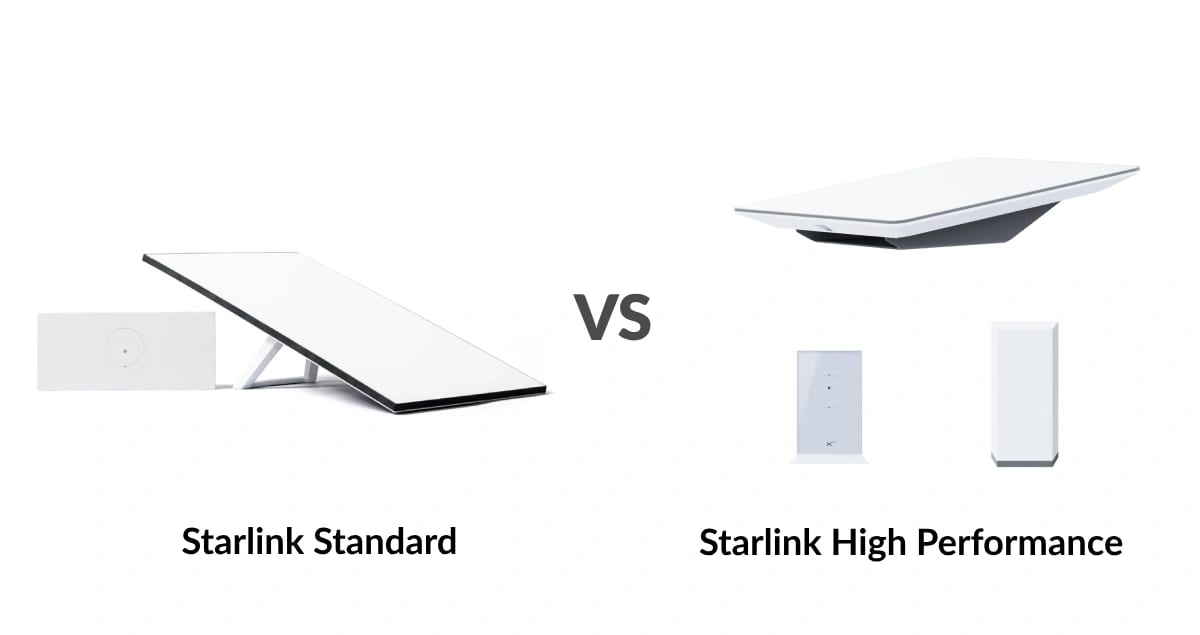
- Starlink Standard Gen 3 ($599 hardware): Features a sleek 23.4" x 15.0" kickstand dish designed primarily for fixed residential roof mounts or portable stationary camping setups. It provides an impressive 110-degree field of view with Wi-Fi 6 router integration.
- Starlink Flat High Performance ($2,500 hardware): Engineered for permanent flat wedge mounting on moving vehicles, boats, and commercial buildings. It packs a larger 22.6" x 20.1" phased array with dual-receiver tracking, multi-constellation GPS, and an expansive 140-degree field of view.
- Starlink Mini ($599 hardware): An ultra-compact 11.75" x 10.2" backpack dish drawing just 25-40W of direct DC power with built-in Wi-Fi, ideal for lightweight vanlife and emergency go-bags.
| Technical Specification | Starlink Standard (Gen 3) | Starlink Flat High Performance | Starlink Mini |
|---|---|---|---|
| Hardware Price (USD) | $599 | $2,500 | $599 |
| Antenna Dimensions | 23.4" x 15.0" (594 x 383 mm) | 22.6" x 20.1" (575 x 511 mm) | 11.75" x 10.2" (298 x 259 mm) |
| Weight (Without Cable) | 6.4 lbs (2.9 kg) | 13.0 lbs (5.9 kg) | 2.4 lbs (1.1 kg) |
| Field of View (FOV) | 110 Degrees | 140 Degrees (35% wider) | 110 Degrees |
| In-Motion Capability | Stationary (Rated up to 10 mph) | Full In-Motion (150+ mph / 240+ km/h) | In-Motion (Up to 100 mph) |
| GPS Tracking Engine | Standard GPS (Single receiver) | High-Precision Multi-Constellation GPS | Integrated GNSS |
| Average Power Draw | 75W - 100W (150W snow melt) | 110W - 150W (250W snow melt) | 25W - 40W (60W peak) |
| Environmental Rating | IP67 (Dust & Water Submersion) | IP56 (Marine Salt Fog & 175+ mph Winds) | IP67 (Rugged Waterproof) |
| Included Router | Starlink Gen 3 Wi-Fi 6 Router | High-Power Supply (Router sold separate) | Integrated Wi-Fi 5 Router |
Field of View (FOV) and Multi-Satellite Tracking
The most significant technical advantage of the Flat High Performance dish is its 140-degree field of view, compared to 110 degrees on the Standard Gen 3. That 35% wider aperture allows the dish to see satellites significantly closer to the horizon:
- Lower Elevation Angle Acquisition: In northern latitudes, mountainous valleys, or dense tree canopies where satellites pass low across the horizon, the Flat HP dish maintains continuous line-of-sight when the Standard dish experiences intermittent outages.
- Simultaneous Dual-Satellite Handoffs: The Flat HP array contains dedicated receive-element subarrays that track incoming and outgoing satellites simultaneously. This eliminates the millisecond packet drop that can occur during high-speed vehicle maneuvers when switching between orbital planes.
- In-Motion Stability: When driving winding mountain roads or navigating pitching ocean swells, the wider viewing cone prevents the dish from losing lock on the satellite constellation.
In-Motion Capabilities and Regulatory Approval
If you intend to use Starlink while driving an RV down the highway, operating commercial transport fleets, or cruising offshore on a yacht, hardware choice and service plan must align with FCC Earth Stations in Motion (ESIM) regulations:
- Flat High Performance: The only hardware formally engineered and warranted by SpaceX for high-speed transit at highway speeds, offshore open-ocean crossings, and emergency response operations.
- Standard Gen 3: While the Gen 3 dish can technically maintain connectivity at low vehicle speeds when mounted flat, it lacks multi-constellation inertial GPS tracking and is officially designated for stationary use. Operating a Standard dish in motion voids warranty claims for wind-shear damage.
- Service Tier Requirement: All in-motion operation requires activating Mobile Priority data through your Starlink account dashboard.
Power Consumption and Off-Grid Electrical Sizing
Power budget is a critical factor for off-grid homesteaders, overland travelers, and marine cruisers:
- Standard Gen 3: Consumes 75W to 100W during standard operation, rising to 150W when internal snow-melting heating elements activate. A modest 200Ah 12V lithium battery bank with 400W of solar panels easily supports 24/7 runtimes. Learn more about battery sizing in our Starlink Power Requirements & Solar Guide.
- Flat High Performance: Draws 110W to 150W continuously, surging up to 250W in freezing snow conditions. Operating this dish on an RV or boat requires robust auxiliary battery banks (400Ah+ lithium) and high-output DC-DC charging or solar arrays.
Which Kit Should You Buy? The Bottom Line
- Choose the Starlink Standard Gen 3 Kit if: You are a residential household, remote worker, seasonal camper, or weekend RVer setting up at campgrounds who values low upfront cost ($599), easy installation, low power draw, and included Wi-Fi 6 router hardware.
- Choose the Starlink Flat High Performance Kit if: You operate commercial vehicles, maritime yachts, open-ocean fishing vessels, or emergency command units that demand unbreakable high-speed connectivity while traveling at 60+ mph, in heavy sea states, or under extreme Arctic weather conditions.
Explore our complete Starlink Dish Size and Dimensions Comparison or browse the Starlink for RVers Guide to plan your mounting and electrical setup.