Starlink Power Requirements: Watts, Monthly Cost & Solar Sizing (2026)
On this page
A Starlink dish draws as little as 25 watts on a Mini and as much as 150 watts on a Flat High Performance terminal in active use, and that gap decides whether your off-grid setup needs a modest 100 Ah battery or an expensive 300 Ah bank. In our hardware and dishes comparison guides, power draw is consistently the single biggest constraint for off-grid homes and mobile rigs. According to the official Starlink Mini specification sheet and the Standard Gen 3 specification sheet, the Mini averages 25 to 40W (18 to 22W idle, 60W peak) while a Gen 3 Standard averages 75 to 100W (20 to 25W idle, 120 to 140W peak with snow melt). Below is the complete 2026 wattage comparison, monthly running cost formulas, and step-by-step 12V solar sizing data.
2026 Power Consumption by Hardware Model
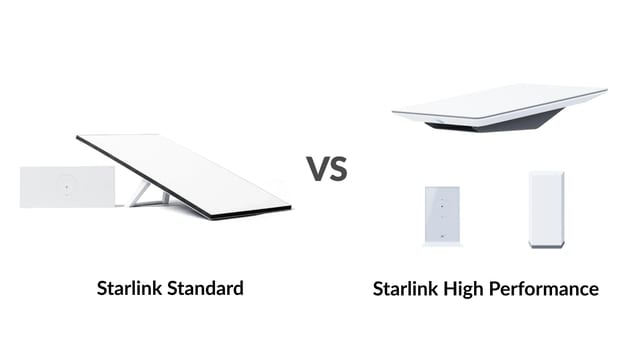
Starlink power consumption and wattage vary significantly across dish generations. Phased-array antenna aperture, transceiver density, and router architecture directly dictate electrical loads. When planning your mount and power system, compare dish dimensions, weight, and mounting footprints alongside our Standard Kit vs Flat High Performance guide. The table below details verified power benchmarks across all five active hardware models.
| Hardware Model | Avg Active Power (W) | Idle Power (W) | Peak / Snow Melt (W) | 24h Energy (kWh/day) | 12V Battery Draw (Ah/day) | Native DC Input? |
|---|---|---|---|---|---|---|
| Starlink Mini (2026) | 25–40 W | 18–22 W | 60 W | 0.60–0.96 kWh | 50–80 Ah | Yes (12–48V DC barrel + USB-C PD) |
| Standard Gen 3 (V4 Kickstand) | 75–100 W | 20–25 W | 120–140 W | 1.8–2.4 kWh | 150–200 Ah | No (Requires 57V PoE step-up) |
| Standard Actuated Gen 2 (Legacy) | 50–75 W | 45 W | 100–120 W | 1.2–1.8 kWh | 100–150 Ah | No (Proprietary 48V PoE) |
| Flat High Performance (Gen 2) | 110–150 W | 45–55 W | 200+ W (High Snow) | 2.6–3.6 kWh | 220–300 Ah | No (Dedicated external PSU) |
| Starlink Enterprise | 110–160 W | 50 W | 220 W | 2.6–3.8 kWh | 220–320 Ah | No (AC supply standard) |
Monthly Electricity Cost Calculations (24/7 Operation)
To calculate how much Starlink energy consumption adds to your monthly electricity bill, use the standard power equation:
Monthly Cost = (Average Watts × 24 hours × 30 days ÷ 1,000) × Electricity Rate ($/kWh)
At the 2026 U.S. national average residential utility rate of $0.16 per kilowatt-hour (kWh), continuous 24/7 power usage costs:
| Model | Monthly kWh (24/7) | @ $0.12/kWh (Low) | @ $0.16/kWh (US Avg) | @ $0.32/kWh (High/CA/HI) |
|---|---|---|---|---|
| Starlink Mini (25–40W) | 18–29 kWh | $2.16 – $3.48 | $2.88 – $4.64 | $5.76 – $9.28 |
| Standard Gen 3 (75–100W) | 54–72 kWh | $6.48 – $8.64 | $8.64 – $11.52 | $17.28 – $23.04 |
| Standard Gen 2 Actuated (50–75W) | 36–54 kWh | $4.32 – $6.48 | $5.76 – $8.64 | $11.52 – $17.28 |
| Flat High Performance (110–150W) | 79–108 kWh | $9.48 – $12.96 | $12.64 – $17.28 | $25.28 – $34.56 |
Running Starlink on 12V / 24V DC (Off-Grid, Campervan & RV)
Running Starlink from an RV or solar battery through a 120V pure sine wave inverter introduces a 15% to 20% efficiency penalty due to DC-to-AC inversion loss, plus an extra 8W to 15W continuous tare load from the inverter itself. In our Starlink for RVers and off-grid setup guide, we demonstrate that wiring directly to DC saves 25 to 45 Ah per day. Paired with Starlink Pause vs Standby mode, direct DC power ensures you never drain your auxiliary battery overnight.
Starlink Mini: Native 12V–48V DC Operation
The Starlink Mini features a native 5.5mm x 2.1mm DC barrel jack on the back of the dish and accepts input voltages from 12V to 48V DC (minimum 60W supply rating). It requires no inverter and no custom PoE injector. You can power it directly from an auxiliary 12V cigarette socket, a dedicated 12V fused circuit, or a 100W (20V/5A) USB-C PD power bank using a USB-C to 5.5x2.1mm PD trigger cable.
Standard Gen 3: DC-DC Boost Converter Setup
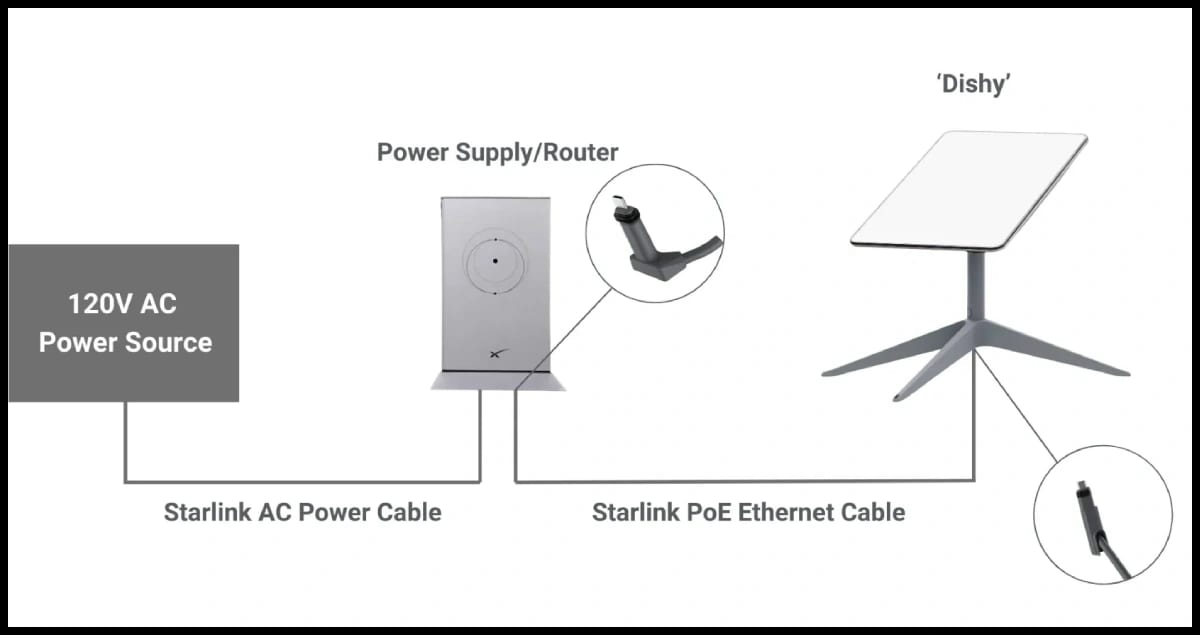
The Standard Gen 3 dish requires 57V DC supplied via its external power supply. To eliminate inverter overhead on 12V or 24V house batteries, wire an auxiliary circuit using a 12V-to-57V DC-DC step-up boost converter (minimum 150W / 3A rating) paired with a standard Gigabit PoE injector. Mind your Starlink cable length limits to avoid voltage drop, and review Starlink Ethernet adapter wiring if connecting third-party mesh routers directly to your DC supply.
| Parameter | Direct DC-DC Converter | 120V Inverter Setup |
|---|---|---|
| Conversion Efficiency | 93% – 97% | 80% – 85% |
| Inverter Tare / Idle Draw | 0 W (Zero idle loss) | 8W – 15W continuous |
| Daily 12V Battery Savings | Save 25–45 Ah / day | Baseline overhead |
Solar Panel & LiFePO4 Battery Sizing Matrix
When sizing an off-grid solar and battery bank for Starlink, calculate based on 100% depth-of-discharge for Lithium Iron Phosphate (LiFePO4) chemistry and plan for 4 to 5 peak sun hours per day.
| Battery Capacity | Total Energy (Wh) | Starlink Mini Runtime | Gen 3 Standard Runtime | Recommended Solar Panel (4h Sun) |
|---|---|---|---|---|
| 100 Ah @ 12.8V | 1,280 Wh | 32 – 42 Hours (1.5+ days) | 12 – 15 Hours | 200W – 300W Panel |
| 200 Ah @ 12.8V | 2,560 Wh | 64 – 85 Hours (3+ days) | 25 – 30 Hours (1+ day) | 400W – 600W Panel |
| 300 Ah @ 12.8V | 3,840 Wh | 96 – 128 Hours (4–5 days) | 38 – 45 Hours (1.5+ days) | 600W – 800W Panel |
Snow Melt Heater & Sleep Schedule Power Optimization
Starlink dishes do not use dedicated resistive heating elements; they melt snow by overclocking phased-array beam transmitters to generate radio-frequency heat. According to the official Starlink Snow Melt support documentation, setting Snow Melt to "Automatic" or "Pre-Heat" triggers power spikes up to 140W on Standard Gen 3 and over 200W on Flat High Performance. Before winter storms, check your obstruction scanning in the Starlink App to ensure heavy snow buildup does not block satellite acquisition, and turn Snow Melt to "Off" on solar power to prevent draining your battery bank.
To further conserve energy, navigate to configuring your Starlink Router settings and enable the Sleep Schedule in Settings > Power. Putting Starlink to sleep between midnight and 6:00 AM drops power draw down to ~18W idle, saving 150 to 300 Wh of battery capacity every night.
Frequently Asked Questions About Starlink Power
Does Starlink need electricity to work?
Yes. Starlink requires continuous electric power. It cannot function without electricity or power because the phased-array dish antenna must actively track and beam-form signals to Low Earth Orbit satellites. Off-grid users must supply power via an auxiliary battery bank, generator, or solar system.
How many watts does Starlink use per hour?
Power draw is instantaneous: a Starlink Mini consumes 25 to 40 watts (0.025–0.040 kWh per hour), a Standard Gen 3 consumes 75 to 100 watts (0.075–0.100 kWh per hour), and a Flat High Performance consumes 110 to 150 watts (0.110–0.150 kWh per hour) during active internet usage.
Can you run Starlink on a 12V car battery?
Yes. The Starlink Mini can plug directly into a 12V battery circuit via its native DC barrel port. The Standard Gen 3 requires a 12V-to-57V DC boost converter or a 120V pure sine wave inverter (minimum 150W). Avoid running the dish off a vehicle starting battery when the engine is off to prevent discharging the starter.
How much power does Starlink Mini consume compared to Gen 3?
The Starlink Mini consumes roughly one-third the power of a Standard Gen 3: 25 to 40W active (0.60–0.96 kWh/day) on Mini versus 75 to 100W active (1.8–2.4 kWh/day) on Gen 3. The Mini is specifically engineered for portable, solar, and campervan deployments.
What size inverter do I need for Starlink?
For Starlink Mini, an inverter is not needed (runs native 12V DC). For Standard Gen 3, size a 150W to 300W pure sine wave inverter to handle initial boot surges. For Flat High Performance, use a 300W to 500W pure sine wave inverter to support snow melt heating spikes.
How much does it cost to run Starlink 24/7 per month?
At the U.S. average utility rate ($0.16/kWh), running a Starlink Mini 24/7 costs $2.88 to $4.64 per month. A Standard Gen 3 costs $8.64 to $11.52 per month. In regions with higher rates like California ($0.32/kWh), Gen 3 costs $17.28 to $23.04 monthly.